
United Nations Simulation
MODEL UNITED NATIONS SIMULATION
Global Crisis. Diplomacy. Power.
OVERVIEW
Welcome to the Model United Nations Simulation, where students step into the role of global leaders navigating real-world crises.
Over the next two weeks, you will:
Represent a country and defend its national interests
Respond to fast-moving global crises
Negotiate with allies and adversaries
Draft resolutions that shape international outcomes
This simulation will evolve:
Phase 1: Crisis Response (fast, reactive, high tension)
Phase 2: Formal UN System (structured debate, resolutions, Security Council)
Background Resources
MODEL UNITED NATIONS SIMULATION
COUNTRY CASE STUDIES (Preparatory Assignment)
Choose and commit. You and one partner will choose one country from your teacher’s list and serve as that country’s two co-ambassadors. You are one delegation, so you must speak with one policy voice and cast one final vote for your country. In major conference models, one or two students commonly represent a country together, and delegates are expected to advocate the assigned country’s interests rather than their personal opinions.
Prepare your country case study. Before the Assembly begins, your team will create one joint PowerPoint that explains your country as a comparative-government case. Your goal is to teach the class how your country’s history, institutions, people, economy, and political priorities shape the way it acts in world politics. Delegates are expected to prepare carefully, and strong preparation begins with researching the country, the issues, and the procedures of the simulation.
What your PowerPoint Case Study must include:
Country snapshot — Official country name, capital, region, population, major languages, key map
Historical turning points — Two to four events that shaped the present political system
Government structure — Regime type, constitution, executive, legislature, judiciary, election system
People and political culture — Ethnic, religious, regional, or class divisions; civic values; legitimacy issues
Economy and resources — Major industries, trade, natural resources, economic strengths and vulnerabilities
State power and constraints — Military, political, economic, and soft-power assets; domestic limits
Current domestic challenges — One to three major internal issues affecting stability or governance
Foreign policy priorities — Alliances, regional interests, security concerns, economic goals
Likely Assembly positions — What this country will probably support, oppose, or try to amend
Bring diplomatic tools, not just slides. In addition to the PowerPoint, each delegation should arrive with a 45–60 second opening statement, a one-page “country priorities” sheet, and at least three policy ideas the country could realistically support. Delegates are expected to prepare what they will say with care and to listen closely to other delegations before taking the floor.
Stay in character during the simulation. Your job is not to argue what you personally believe. Your job is to represent your assigned country as accurately and professionally as possible. During the simulation, you should speak in caucuses, negotiate with other countries, help write at least one working paper, contribute to at least one draft resolution, and explain your final vote if called upon to do so.
Bring issues that matter now. Your teacher may present agenda items to the Assembly, but you may also petition to add an issue if you can show that it matters to more than one country, fits the scope of the Assembly, and connects to your country’s interests. The purpose of consultations in diplomatic settings is to make positions known, gather information, and discover where coalitions are possible, so issue proposals should emerge from research and consultation rather than from surprise speeches alone.
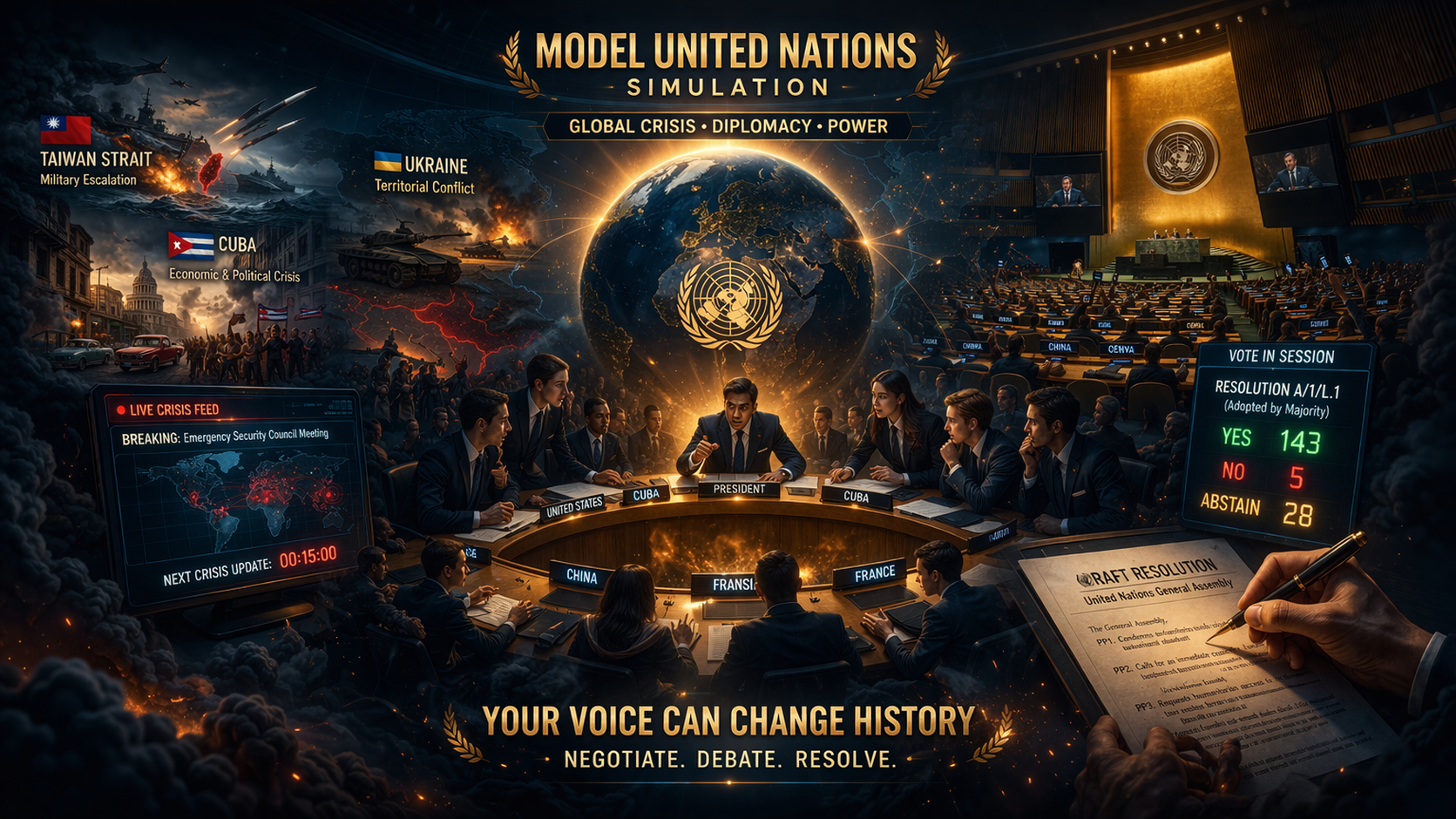
YOUR ROLE
Each student is assigned a country and will act as that nation’s:
Diplomat & Ambassador
Strategist
Negotiator
You are responsible for:
Understanding your country’s history, alliances, and goals
Communicating with other nations
Making decisions that impact global stability
You are not yourself—you are your country.
Committee and General Assembly Roles:
Rappateur (Note taker/resolution tracker)
CRISIS BRIEFINGS:
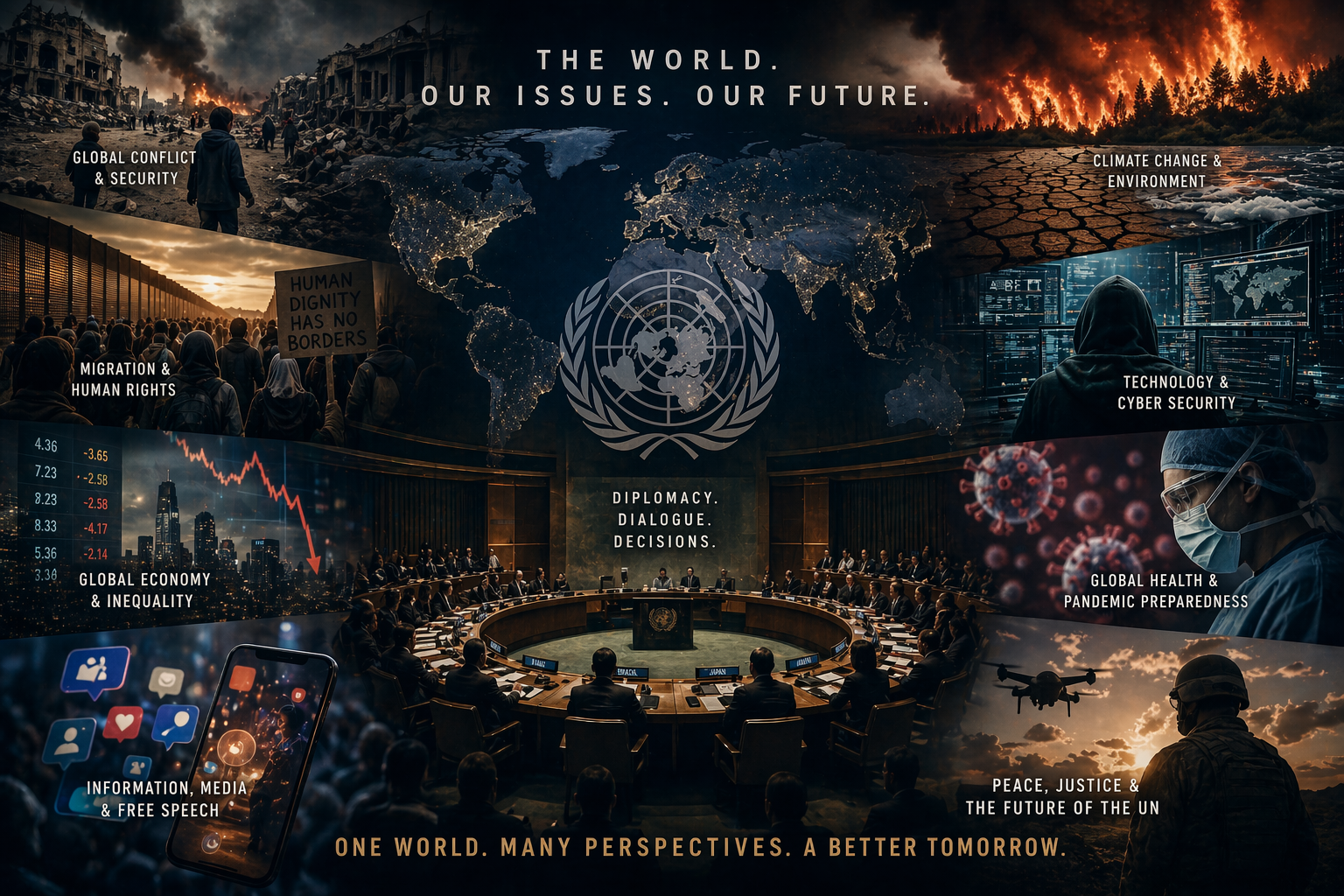
Global Issues for the General Assembly and Security Council
Find TWO major issues from this list (or create TWO of your own based on your country’s objectives in the current world order), and draft a RESOLUTION for each of them. You will then have the opportunity in the simulation to present your resolution if you bring it to the floor. You must have Chair approval and a second to bring the resolution to the floor for debate.
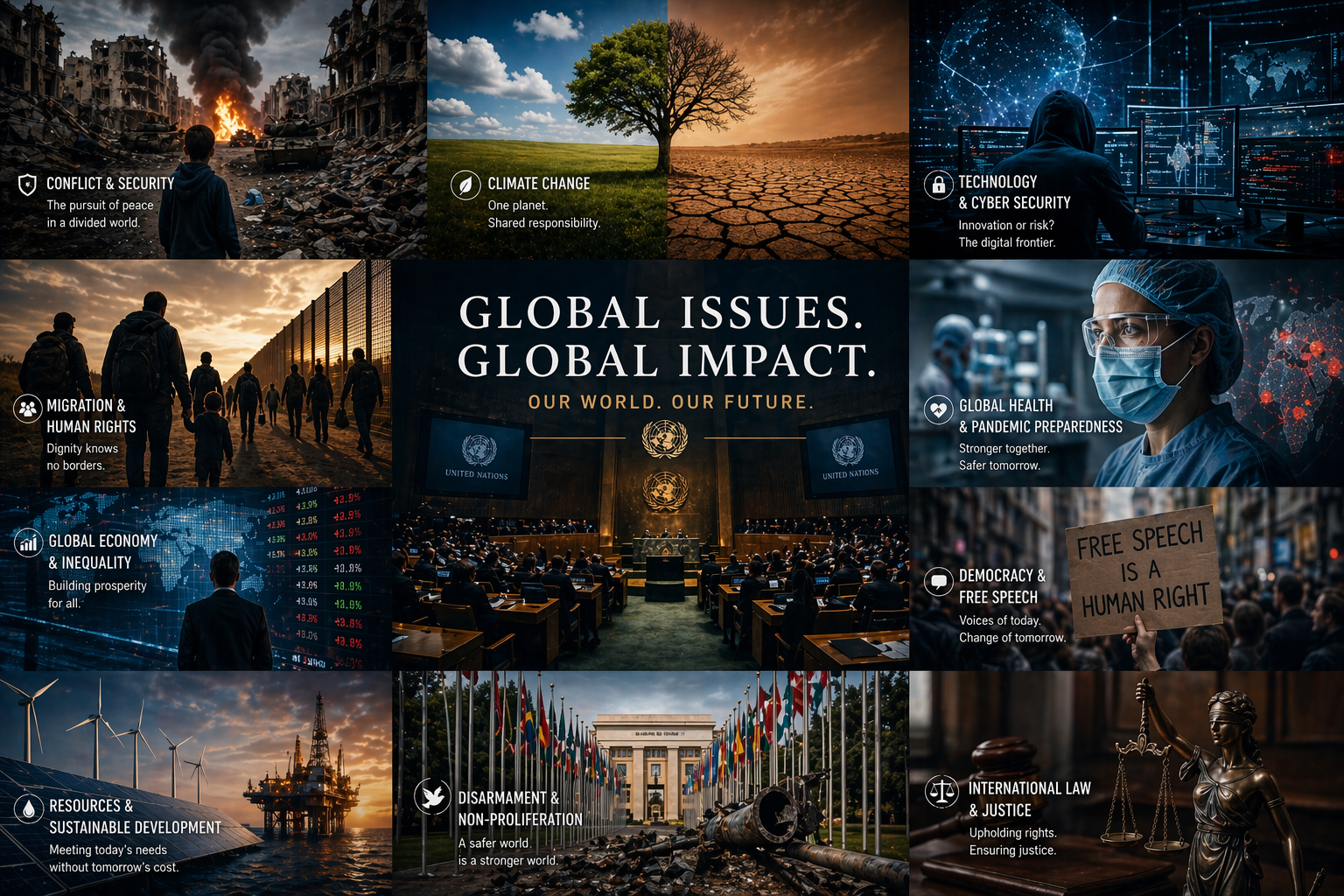
Global Issues for Resolution Writing
1. Global Conflict & Security
War in Ukraine
Should the international community increase military aid or push for negotiated peace?
Should sanctions on Russia be strengthened or reduced?
What role should NATO or the UN play?
Israel–Palestine Conflict
Should there be a two-state solution, one-state solution, or alternative?
How should humanitarian aid be delivered and monitored?
Should international forces intervene?
Taiwan Tensions
Should the UN formally recognize Taiwan?
How should countries respond to potential Chinese military action?
Should economic sanctions be used as deterrence?
Cyber Warfare & Digital Attacks
Should cyberattacks be treated as acts of war?
Should there be global limits on hacking and cyber espionage?
How do you enforce digital accountability?
2. Migration, Borders, & Human Rights
Global Migration Crisis
Should countries have the right to fully close borders?
Who is responsible for refugees: neighboring countries or global community?
Should there be UN-enforced migration quotas?
Human Rights vs National Sovereignty
When should the UN intervene in domestic human rights abuses?
Should countries lose sovereignty if they violate human rights?
U.S.–Mexico Border & Global Immigration Policy
Should stricter border enforcement be global policy?
Should economic aid be used to reduce migration?
3. Climate & Environmental Crisis
Climate Change Responsibility
Should major polluters like United States and China pay more?
Should developing nations be held to the same standards?
Fossil Fuels vs Green Energy
Should the UN phase out fossil fuels globally?
What happens to countries dependent on oil economies?
Climate Refugees
Should climate refugees receive special international protection?
Who pays for relocation?
4. Global Economy & Inequality
Economic Sanctions
Do sanctions actually work, or do they harm civilians more?
Should sanctions require UN approval?
Global Debt Crisis
Should developing nations have debt forgiven?
Should wealthier nations be required to assist?
AI, Automation, and Jobs
Should there be global regulation of AI?
Should countries limit automation to protect workers?
5. Science, Technology, & Ethics
Artificial Intelligence Regulation
Should AI development be globally controlled?
Who decides what AI is “safe”?
Genetic Engineering
Should countries be allowed to genetically modify humans?
Should there be global bans?
Social Media & Free Speech
Should governments regulate misinformation?
Where is the line between free speech and harmful speech?
6. Global Health & Biosecurity
Pandemic Preparedness
Should the UN have authority to override national decisions during pandemics?
Should vaccines be globally shared or nationally controlled?
Big Pharma & Access to Medicine
Should life-saving drugs be free worldwide?
Should patents be eliminated during crises?
7. Power, Influence, and the Future of the UN
Reforming the United Nations
Should the Security Council veto power be abolished?
Should new countries be added as permanent members?
Rise of Superpowers
Is the world becoming multipolar?
How should smaller countries respond to dominance by major powers?
OPTIONAL “RISKY” BONUS ISSUES:
Mandatory Military Service
Should all nations require it?
Nuclear Weapons
Should all nuclear weapons be eliminated—or are they necessary?
Government Surveillance
Should governments monitor citizens for safety?
Internet Control
Should countries control access to information?
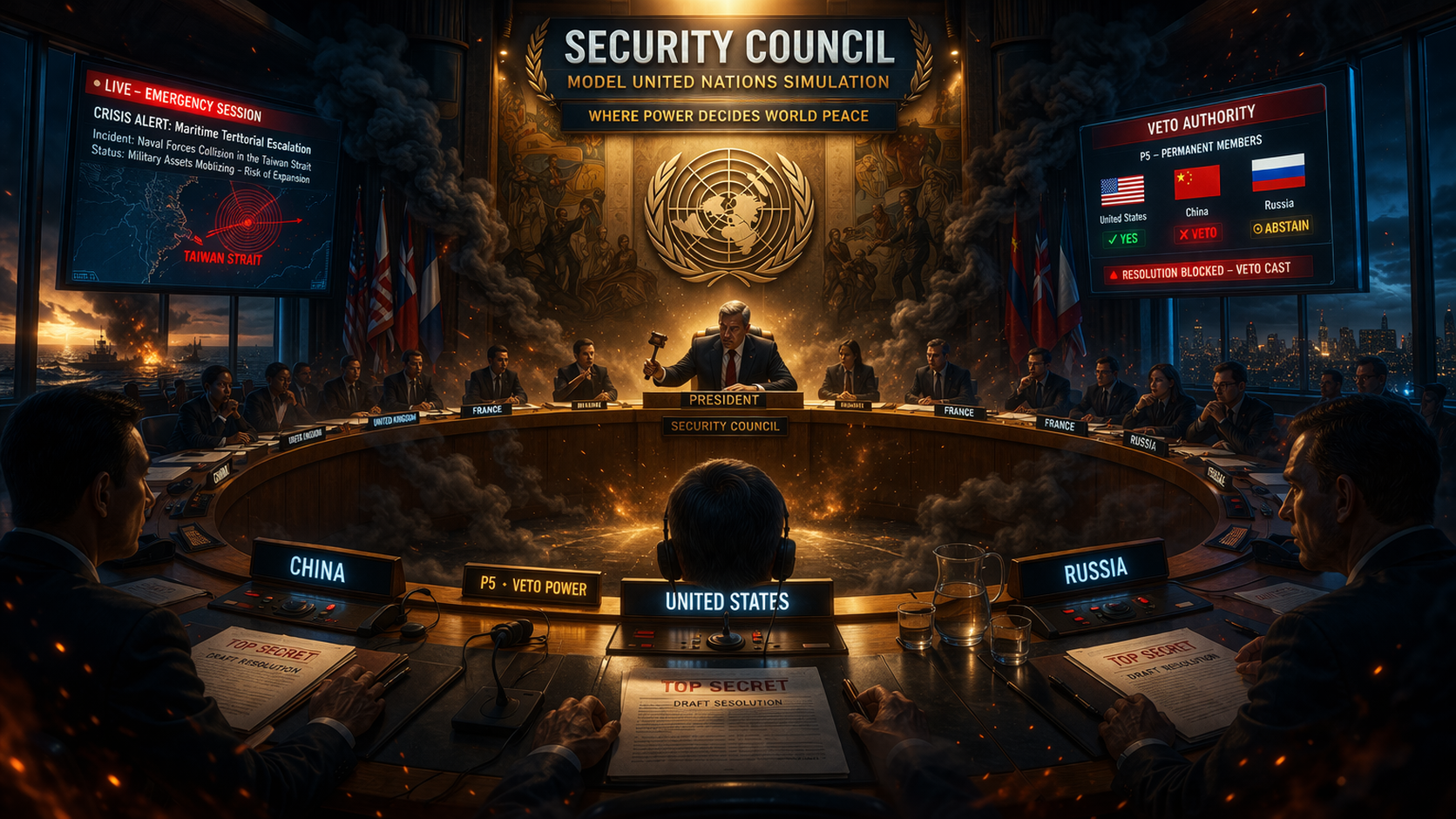
UNITED NATIONS SYSTEM
As the simulation progresses, we transition into a structured UN system:
General Assembly
Open debate
Resolution writing
Majority voting
Security Council
5 Permanent Members + rotating nations
Power to pass binding resolutions
Veto authority changes everything
CORE OBJECTIVES
By the end of this simulation, you will:
Understand how global diplomacy actually works
Experience the challenges of international cooperation
Analyze how power, alliances, and interests shape decisions
RULES OF ENGAGEMENT
Stay in character at all times
Speak from your country’s perspective
Respect diplomatic protocol
All actions must go through:
Debate
Negotiation
Official submissions
SUCCESS IN THIS SIMULATION
To succeed, you must:
Be strategic, not just reactive
Build alliances early
Use leverage (economics, military, diplomacy)